
You're ready to book a cleaning and the only question left is when. In the Bay Area, the calendar month matters less than which stretch of the soiling year you're in.
The East Bay soiling calendar
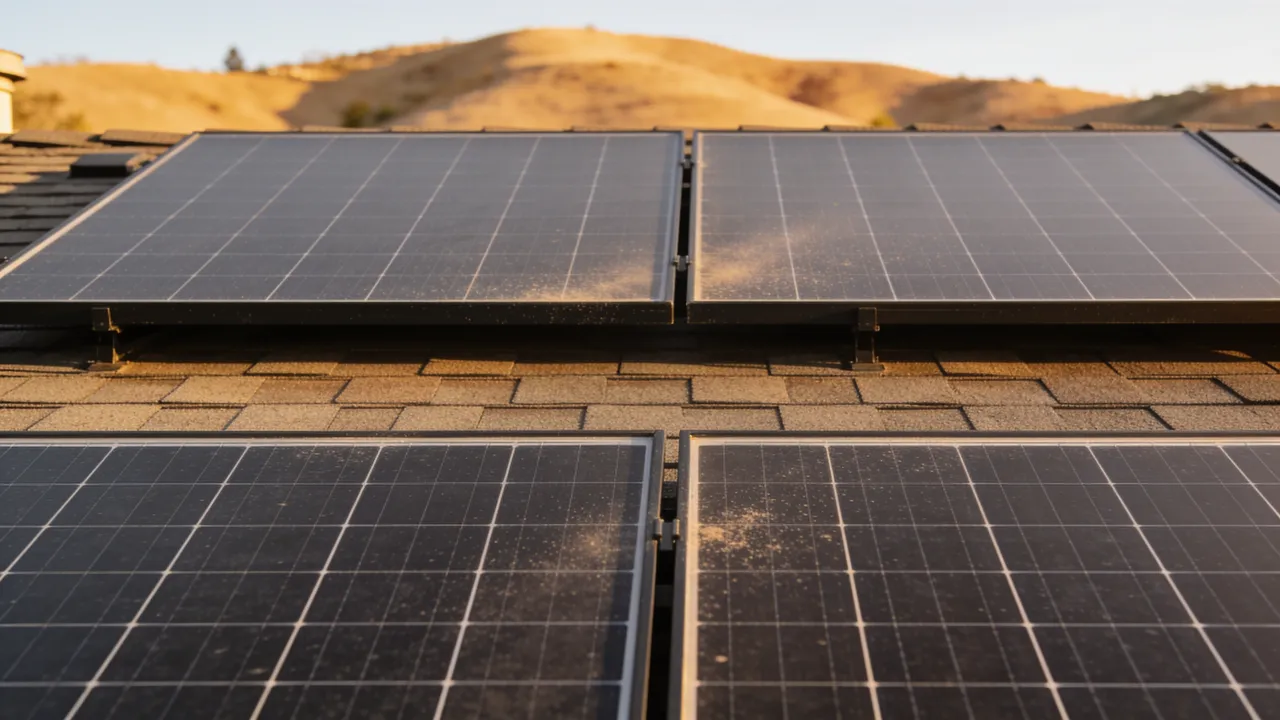
Panels here don't get dirty all at once. Oak and bay laurel pollen coats everything from February through May and bonds to the glass by early summer, the buildup we cover in detail in our guide to cleaning frequency. Once the rain shuts off for the summer, dry offshore Diablo winds kick up dust that settles on panels day after day with nothing around to rinse it off. Late summer into early fall carries the sharpest risk: wildfire smoke drifting in from the Diablo Range or further north, and ash that bakes into whatever soiling is already sitting on the glass.
Winter rain does a partial job and stops there. It rinses away the loose dust that piled up over the dry months, but it doesn't touch pollen film or baked-on ash, and wet pollen often dries into a tighter coating than it started as. We walk through why in our piece on whether rain actually cleans solar panels.
The two windows that actually work
Late spring, once the pollen wave finishes, is the first window. Clean right after that and you remove the season's accumulated film before the long rainless months lock it in, and you start the year's highest-production stretch on clear glass instead of a coated one.
Early fall, after fire season eases but before the first real rain, is the second window. That clean pulls a full dry season's worth of dust, pollen residue, and any ash off the panels before rain gets a chance to bond it into something harder to remove. Time it too early and you're still inside fire season; time it too late and the first storm has already turned dry soiling into a bonded film.
Why mid-winter and peak-summer cleanings underperform
A mid-winter cleaning fights an environment that keeps re-soiling itself. Rain has usually already started by then, and washing panels right before or during a wet stretch means the next storm can leave behind the same muddy pollen film a cleaning just removed.
A peak-summer cleaning, deep in July or August, comes too late for a different reason. By then, panels have already carried a full spring and early summer's worth of pollen and dust through the year's sunniest months, so the window to protect that stretch of output has already closed by the time anyone books it. Peak summer also sits inside fire season, which means a clean scheduled during a smoke-prone week can need a second visit soon after if an ash event lands right on top of it.
None of this is exact science. Weather doesn't check a calendar, and a late spring storm or an early smoke event can shift both windows by a couple of weeks in either direction. Total Solar Cleaning's booking calendar tracks that shift year to year rather than pinning it to fixed dates.
What this looks like in Concord, Walnut Creek, and Antioch
Concord's inland heat and pollen give it a longer dry-soiling window than the foggier coast, so both the late-spring and early-fall visits carry more weight here than they would closer to the Bay. Walnut Creek's tree pollen in spring is a common trigger for a first clean of the year, which is usually the signal to book the late-spring window rather than wait. And Antioch's hotter, dustier east-county summers push the pre-rain fall clean earlier than it would sit in a milder part of the East Bay.
Total Solar Cleaning serves the full East Bay from our Concord base. Call (833) 444-4173 to schedule a cleaning timed to your part of the soiling calendar, or request a quote online.