
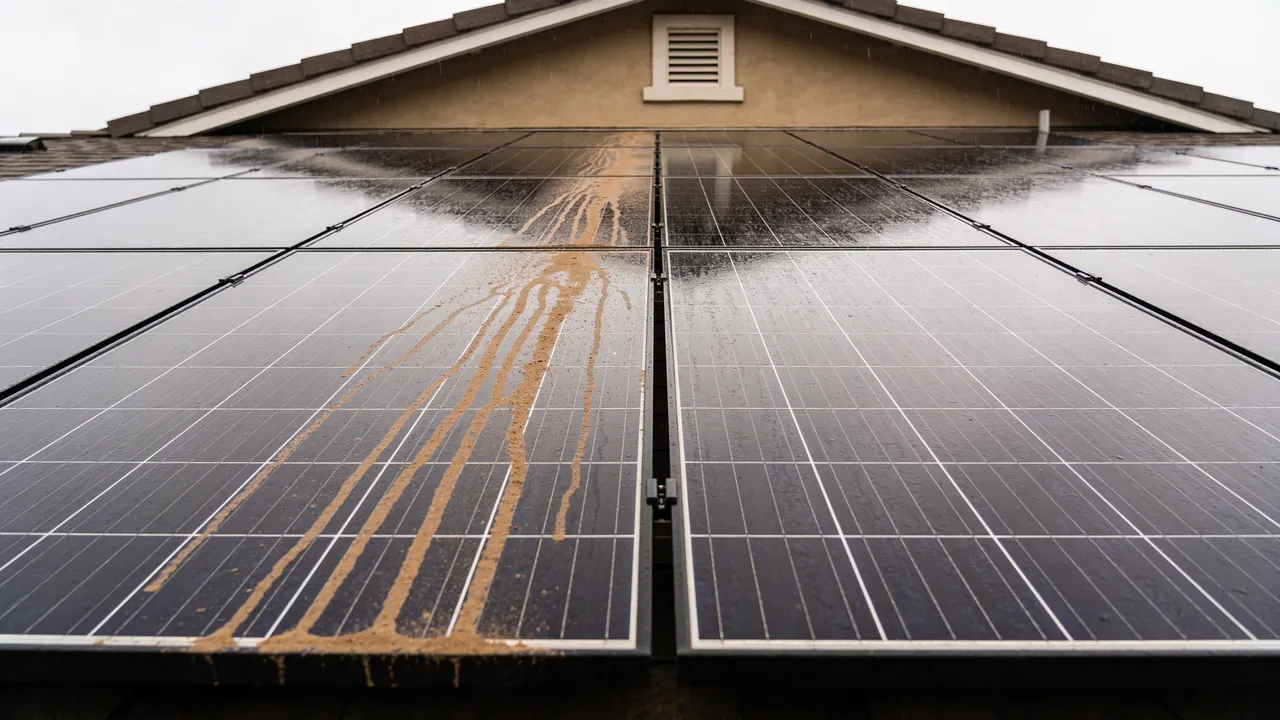
Rain does not clean solar panels well enough to skip a real cleaning. It washes away the light, loose dust that was going to blow off anyway. The soiling that drags down your output stays put, and in some cases rain bonds it tighter to the glass.
The short answer, and where the myth comes from
The idea that rain keeps panels clean comes from desert and arid-climate studies where the only soiling is fine, dry dust. In that setting a heavy rain can rinse most of the dust away and the benefit of cleaning is small. That finding is real, and Total Solar Cleaning will not pretend otherwise.
The problem is that the finding does not transfer to the East Bay. Bay Area panels are not dirty from dry dust alone. They carry bird droppings, tree and grass pollen, wildfire ash, and road grime, and none of those rinse off in a rain shower. Rain moves the easy stuff and leaves the expensive stuff behind.
What rain removes, and what it leaves behind
Rain removes loose surface dust. Water sheets across the glass, picks up dry particles, and carries them off the lower edge. If dust were the only thing on your panels, a good storm would handle most of it.
Rain does not remove bird droppings. Droppings are mostly uric acid, which bonds to the glass and does not dissolve in water. A rain shower softens the surface of a dropping and spreads it into a wider stain, then it dries back down. The droppings shade whole cells and can create hot spots, the same way they do when rain fails to clear bird droppings off panel glass. Rain also leaves pollen film, which is the part most Bay Area homeowners underestimate.
Why Bay Area rain often makes panels dirtier
Dry pollen sits on the glass as a loose powder. Add water and it does the opposite of washing away: the pollen clumps, binds, and dries into a tighter, more opaque film than it was as dry dust. A wet-then-dry cycle turns a light dusting into a bonded coating that blocks more light, not less.
That is a local effect, not a general one. In Danville, where valley oak canopy releases heavy spring pollen, rain mixes with the pollen film and dries as a muddy coating more opaque than dry pollen alone. Homeowners see the panels get wet, assume the rain did the work, and are surprised when output does not recover.
Traffic grime and combustion residue
Panels near busy roads collect oily particulates from traffic and combustion. That grime is greasy, not dusty, so water beads off it instead of lifting it. Rain can streak it around without removing it, leaving a thin haze that cuts light transmittance. Concord's position near Interstate 680 and Highway 4 means panels accumulate oil particulates and combustion residue that rain doesn't dissolve. Lifting that film takes deionized water and a soft brush, not a passing shower.
Rain spots, and the trap of finishing with a hose
Even clean rain leaves a mark. As a raindrop evaporates on warm glass it concentrates the dust and airborne particulates it carried, then dries as a small spot, the same way rain spots a car. Where winter rainfall is light, those spots are not even rinsed off by a following storm. Dublin's Tri-Valley location means limited winter rainfall, and even the rain that does fall leaves enough mineral deposits on the glass to warrant annual cleaning at minimum.
Some homeowners try to help the rain along with a garden hose. That backfires, because tap water carries its own minerals. The East Bay Municipal Utility District publishes its annual water quality data for the area. Spray it on a sun-warmed panel and it dries into a calcium film, so the hose trades loose dust for a bonded deposit.
When rain is actually enough, and when it is not
Rain is close to enough on a flat, ground-level panel in a dry-dust setting with no bird activity, no nearby trees, and no road grime. If that describes your system, you can stretch the time between cleanings.
For a typical East Bay roof it is not enough. Between bird droppings, spring pollen, summer dust, and road haze, most homes here still need cleaning one to two times a year, and rain does not change that math. For how that schedule works by location, see our guide on how often to clean solar panels in the Bay Area, and for more answers see the FAQ.
Total Solar Cleaning is ISCA-certified, uses deionized water and soft-bristle tools, and removes the bonded soiling that rain leaves behind. Call (833) 444-4173 to schedule a cleaning or request a quote online. You do not need to be home. Leave the gate unlocked and Total Solar Cleaning handles the rest.