
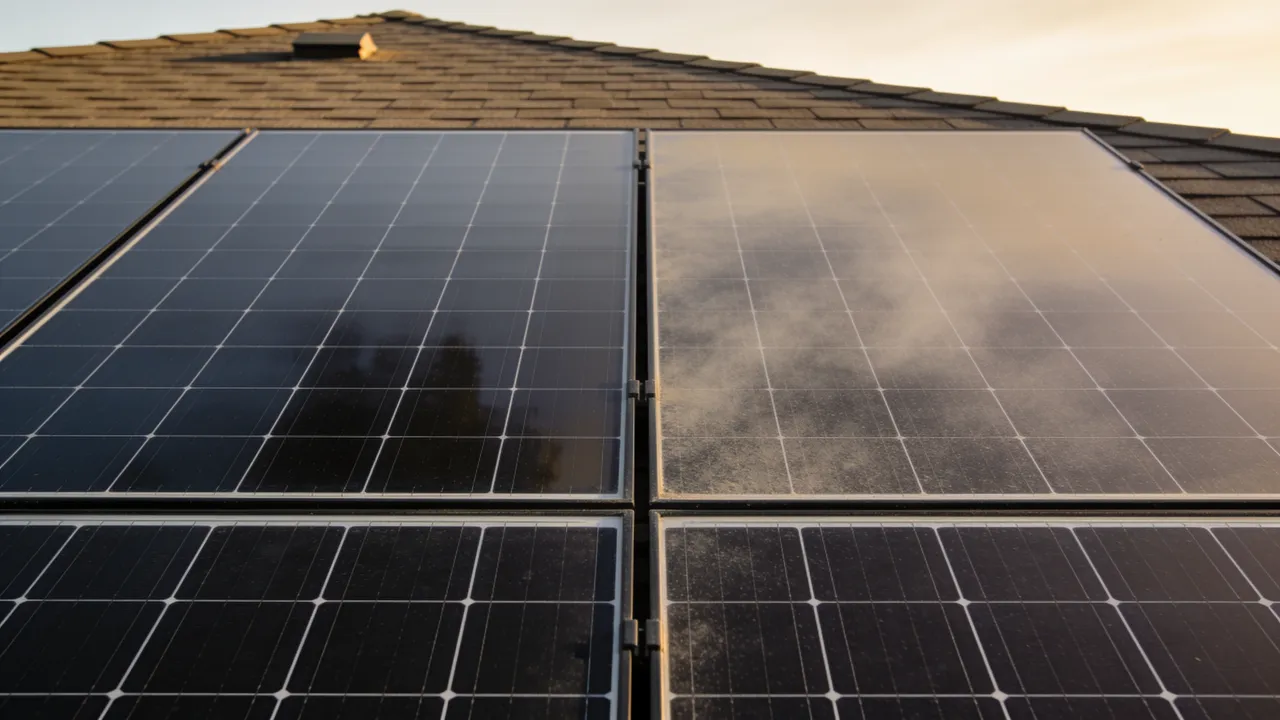
You are standing in the driveway, looking up at your panels, trying to decide if a cleaning is worth it. Most of the answer is visible from where you stand.
What a dirty panel looks like from the ground
A gray or hazy film across the glass is the most common sign. Clean panel glass reads dark and reflective. A coated panel reads dull and gray, and the film sits evenly across the whole array instead of in spots. That even film is usually dust and pollen, the buildup that collects through the East Bay's dry months and never rinses off. A film matters because panels make power by letting light reach the cells under the glass, the path the U.S. Department of Energy's overview of photovoltaic technology explains in plain language.
Concentrated bird droppings are a different signal. They show up as white or dark spots, and a single dropping shades the cell under it. Droppings also do not rinse off in rain, which is why they matter more than a thin film. The full mechanism is in our post on why rain will not remove bird droppings.
Pollen streaks are a third sign. Pollen collects as a yellowish film, most visible at the lower edge of each panel where water and debris pool. Moss or algae at the frame line is the fourth, and it shows as green growth along the panel edges rather than across the glass, on shaded roofs that stay damp. That growth is a separate problem from dust, and we cover it in our post on moss and algae on shaded roofs.
How long since the last cleaning
Time since the last clean is a fast proxy. Most Bay Area homes benefit from a cleaning once or twice a year. If it has been a year or more, and the array has sat through a dry summer, a visible film is the expected result.
The dry months are the part that matters. From May through October the East Bay gets almost no rain, so dust and pollen land and stay. A panel that was clean in spring carries a summer's worth of buildup by fall. If your last cleaning was before the dry season and you can see haze from the ground, the panels are due.
When a cleaning will not help
Some panels look dirty and still do not need a cleaning, and some problems are not dirt at all.
Shade is the most common false alarm. A tree that leafed out in spring can dim part of the array at certain hours, and no cleaning fixes that. A hardware fault, like an offline microinverter or a tripped breaker, cuts output too, and the panels can look perfectly clean while it happens. The winter dip is the third case: shorter days and a lower sun angle cut output every winter, and that is just the season.
Your monitoring app separates these. A slow, week-over-week decline on clear days points to soiling. A sudden drop points to shade or a fault. Reading the difference is covered in our post on what a production drop means.
What to check before you book
Run through these from the ground, in order. Look at the glass from the driveway. A gray or hazy film, droppings, pollen streaks, or moss at the edge means soiling. Check the time since the last clean. A year or more, or a full dry summer, supports cleaning. Open your monitoring app. A slow decline on clear days is soiling; a sudden drop is shade or a fault. Rule out shade. If the dip lands at the same hour every day, look to the tree first.
If the glass is hazy and the decline is gradual, a cleaning will help. If the glass looks clean and the drop was sudden, a cleaning will not. Residential cleaning runs $175 to $350, so it is worth getting the diagnosis right before you spend.
What this looks like in Walnut Creek, Concord, and Danville
Walnut Creek homeowners with tree-lined streets can often spot the pollen film from the driveway once they know what to look for. In Concord, where summer dust and spring pollen both build gradually, a year or more without cleaning usually shows as a visible haze. Danville's mature landscaping adds leaf debris and bird activity that show up as concentrated spots on the glass.
Total Solar Cleaning removes dust, pollen, droppings, and frame-line growth with deionized water and soft-bristle brushes, which leave no mineral film behind. The crew is ISCA certified and carries $2 million in liability coverage. Call (833) 444-4173 for a quote, or request one online. You do not need to be home for the work itself.