
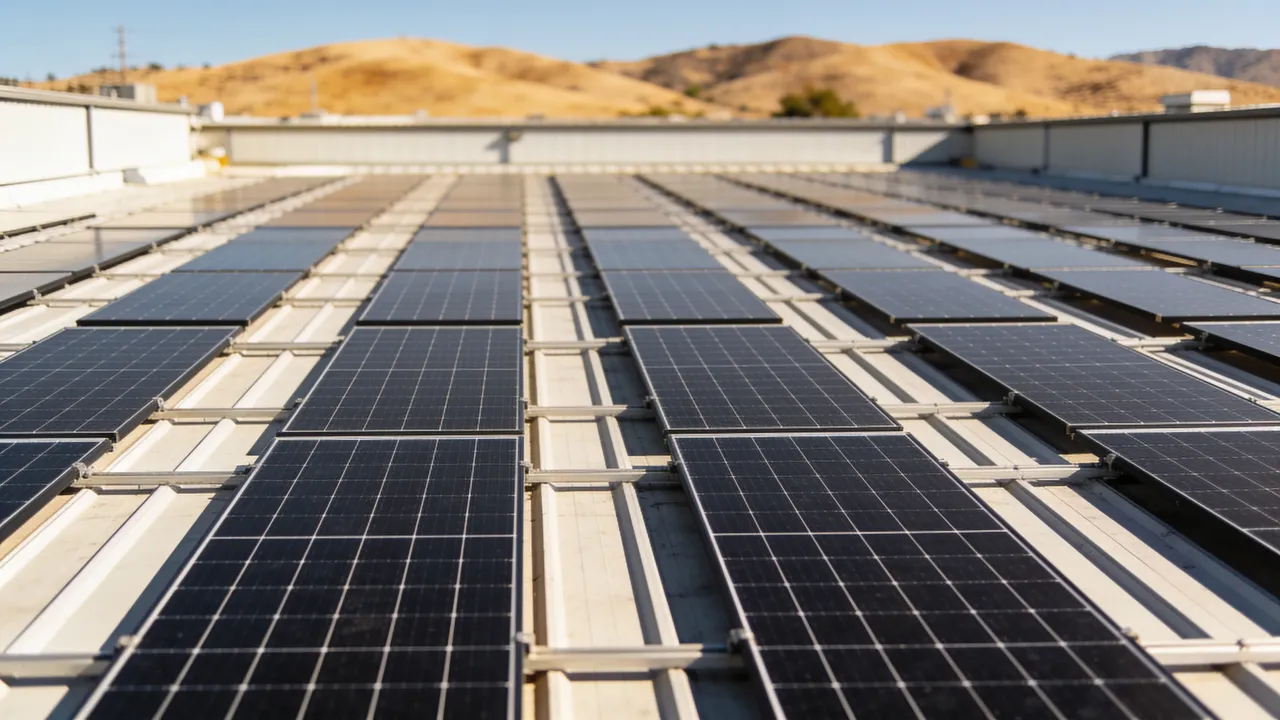
A commercial array earns money for the business that owns it. When dust, bird droppings, and pollen build up across hundreds of panels, the lost output adds up faster than on a home roof.
How commercial cleaning differs from residential
Commercial solar cleaning differs from residential in two ways: access and stakes. A Contra Costa or Alameda County business often runs an array several times the size of a home system, mounted on a flat commercial roof, a carport, or a ground mount rather than a pitched residential roof.
That changes the math. On a home, panel count is the headline number. On a commercial site, how the crew safely reaches the array usually moves the price more than how many panels there are. A flat single-story warehouse roof in Concord is a straightforward job. A four-story office array in Oakland that needs a boom lift and a traffic plan is not.
The output stakes are also higher. A commercial array is sized to offset a business electricity bill, so every percentage point of soiled output is a larger dollar figure than on a residential system. UC San Diego's 2013 study of 186 residential and commercial California sites, from the San Francisco Bay Area south, found panels lost about 7.4% over a 145-day dry spell. Commercial rooftops lost more in dollars, though dust alone rarely paid for a wash, and the researchers said very large arrays may be the exception. They also named the cases that do warrant cleaning: heavy bird droppings, which rain does not remove, and sites downwind of a highway, factory, or farm field. Arrays tilted under five degrees also lost more. See our guide to whether solar panel cleaning is worth it in the Bay Area.
Roof access drives the East Bay quote
A ground-mounted array or a flat roof a crew can walk safely is the cheapest to service. Height, pitch, skylights, and rooftop equipment all add time, gear, and risk, and that shows up in the quote.
Commercial arrays fall into three access groups:
- Ground mount or low flat roof: the crew walks the rows, so setup is light and most of the visit goes to cleaning.
- Carport or parking canopy: the canopy is cleaned from above. Total Solar Cleaning owns a SolarCleano F1 robot that goes onto the canopy by lift, which suits carports of roughly 300 panels and up.
- Multi-story rooftop: lift or roof access plus fall protection before any cleaning starts, which makes it the most setup-heavy group.
A quote built without the address and access details is a guess. For how the commercial number is put together, see how much commercial solar panel cleaning costs.
Why quarterly contracts make sense for businesses
A quarterly contract with Total Solar Cleaning runs about 20% below one-off pricing for the same site. The visits are on the calendar, so nobody on your side has to notice dirty panels and chase a booking. Work can be scheduled for evenings, weekends, or overnight to keep it out of parking and business hours. You deal with one point of contact, and each visit comes with before-and-after photos for the facilities file.
The interval should still follow the site. A carport under a bird roost or an array downwind of a freeway may need more visits; a well-tilted roof array that rain rinses may need fewer. A year of visit photos shows which one you have. If ash or a bird problem hits between visits, emergency cleaning is available.
Safety and liability on a commercial roof
Commercial solar cleaning is work at height around live electrical equipment, and it carries real liability. A business owner hiring a cleaner is putting a crew on the roof over an energized PV system, so credentials and insurance matter as much as price.
Owner Mitch McKay holds the Certified Solar Panel Cleaner credential from the International Solar Cleaning Academy, and the company carries $2 million in general liability coverage and workers' compensation. For public-works jobs such as school districts, Total Solar Cleaning is registered with the California Department of Industrial Relations (PWCR 2000010661) and runs certified payroll. The company holds six recurring commercial accounts, and the largest is a 3.5 MW school-district contract across 18 sites. Ask any vendor for a current certificate of insurance and the access and fall-protection plan for your site.
The cleaning method on a large array
On a commercial array the method has to be both safe for the panels and consistent across hundreds of units. Total Solar Cleaning uses deionized water, which holds under 10 ppm of dissolved minerals and rinses away with no residue, so a large array dries clean rather than streaked with a mineral film.
Tap water leaves minerals behind. Whatever is dissolved in it stays on the glass when the water dries, and across hundreds of panels that residue builds into a haze that cuts the light reaching the cells. The chemistry is the same as on a home, just multiplied, and we explain it in detail in our post on why deionized water beats tap water for solar cleaning. The full method, deionized water and soft-bristle brushes with no chemicals and no pressure washing, follows published manufacturer cleaning guidelines.
Where we serve East Bay businesses
Total Solar Cleaning serves commercial sites across Contra Costa and Alameda counties from its base in Concord. That covers business arrays in Concord, Fremont, Oakland, Hayward, Livermore, and the surrounding East Bay.
Commercial arrays are quoted custom after a look at the roof, the access, and the cleaning frequency that fits the site. To get a commercial quote, call (833) 444-4173 or use the commercial quote form. The same number covers residential service.