
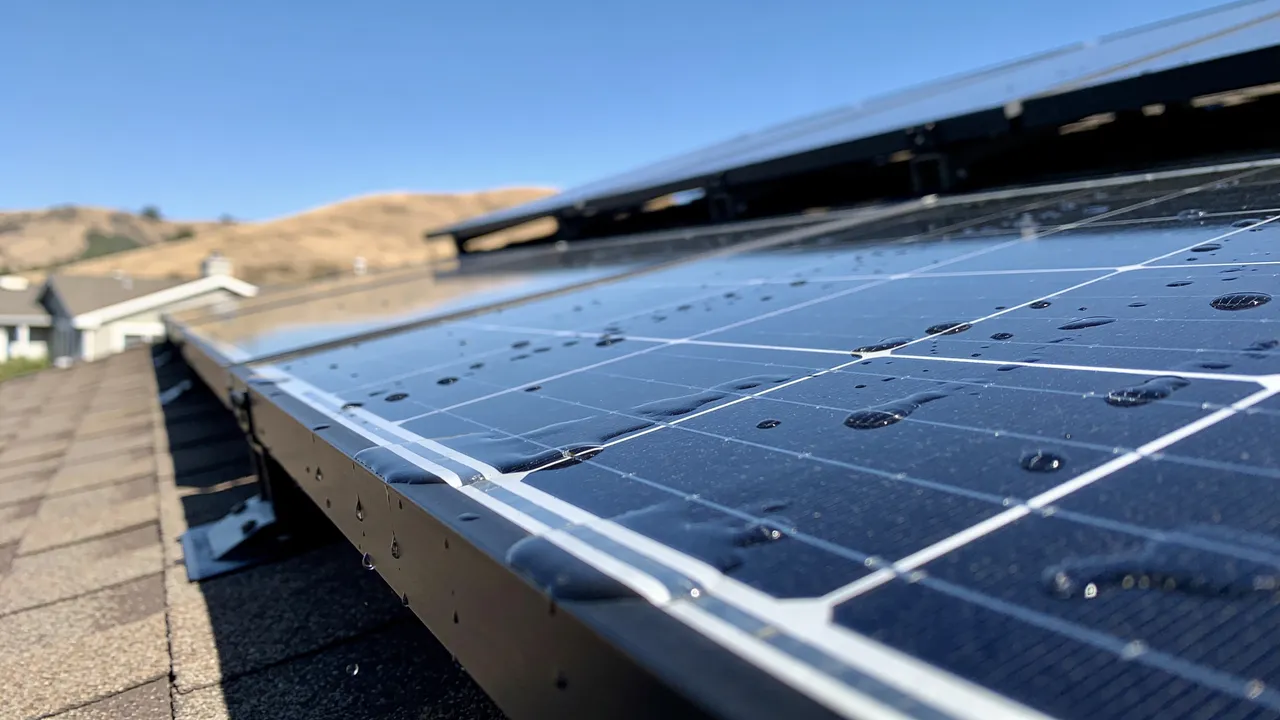
Wash a car in the sun with the hose, walk away, and you come back to spots. Solar glass does the same thing, and it sits in full sun all day.
Why tap water leaves spots on solar panels
When water evaporates, the minerals in it stay behind. On a hot panel that happens in minutes, so every drop that dries in place leaves a small ring of residue. Even soft water carries some. The East Bay Municipal Utility District's water quality data showed treatment-plant samples from about 36 to 143 milligrams of dissolved solids per liter in October 2026, and most of that water counts as soft.
One round of spots is a cosmetic nuisance. Repeat tap-water rinses through a dry summer and the spots build into a hard-water film that more tap water won't shift.
What is deionized water?
Deionized water is water run through ion-exchange resin, which pulls out the dissolved minerals and salts that ordinary tap water carries. Calcium and magnesium are the usual ones. What comes out the other side is close to pure water, with almost nothing left in it to dry onto a surface.
Panel maker REC recommends deionized water. Its quick guide to cleaning its panels says that ideally de-ionized water should be used, and lists rainwater or tap water only as the fallback when it isn't available.
Is deionized water necessary, or is a garden hose fine?
For a quick rinse on panels you can reach from the ground, a hose is fine. REC lists tap water as a second choice, and its guide says a standard garden hose at household pressure may be used. Do it early in the morning, while the glass is still cool, so the water runs off before it can bake on, and skip the soap.
Deionized water earns its place when the panels are going to air-dry in the sun, which is most cleanings on a roof. Nobody has to wipe or squeegee the glass afterward, so nobody has to lean on it either.
What to ask a solar cleaner about water
Ask what water goes on the glass and how the panels dry. It's a one-line question, and the answer tells you a lot. A crew that rinses with a garden hose and lets the roof dry in the afternoon sun will leave spots behind, however careful the brushwork was. A crew using deionized or other purified water can let the panels air-dry and walk away from clear glass.
Ask a cleaner about soap as well. Detergent leaves its own film unless every trace is rinsed off, and REC's guide rules out acid and alkali detergents on its panels. Plain deionized water and a soft brush need nothing rinsed off afterward.
Our method: brush first, then a deionized rinse
Water alone doesn't lift bird droppings, baked-on pollen or a summer of dust. At Total Solar Cleaning, a soft-bristle brush on a water-fed pole loosens that, and deionized water carries it off and dries clear. We don't use soap or a pressure washer.
Brush first, then a deionized rinse, is the method REC's cleaning guide describes. Warranty terms are set by the company that made your panels, and our warranty guide shows where to find what your panel maker's terms say.
To book a deionized-water cleaning, call (833) 444-4173 or send the contact form with your address and a rough panel count.