
Most search results for this query publish per-panel averages from national lead-gen sites that don't hold up against actual commercial jobs. Total Solar Cleaning quotes commercial cleaning on the variables that move the price, and this post explains what those are.
What actually drives a commercial cleaning quote
Four variables determine what a commercial solar cleaning job costs: array size, roof access, soiling level, and cleaning frequency.
Array size is the starting point. Total Solar Cleaning measures commercial jobs by panel count and the physical layout of the installation. A 50-panel array on a single accessible rooftop section is a bounded scope. A 200-panel system across multiple roof levels with internal drainage channels and separate equipment hatches is a different project, and the quote reflects the actual scope.
Roof access changes the price more than panel count in many cases. Concord's commercial corridors along Monument Boulevard carry some of the East Bay's larger rooftop arrays, where access drives the quote more than panel count. A rooftop with a clear working perimeter and a low parapet means standard ladder setup. A building where the roof edge drops to a parking structure, or a multi-story property where OSHA fall protection applies to the perimeter, adds safety rigging and additional crew time that a flat per-panel rate doesn't capture.
Soiling level matters most on the first professional cleaning of a system without a documented maintenance history. Bird colonies roosting near the array, industrial particulates from nearby operations, and mineral buildup from prior tap-water rinse jobs all take longer to clear than routine quarterly maintenance soiling. Total Solar Cleaning evaluates soiling before quoting on systems without records.
Cleaning frequency determines per-visit cost more than any other single variable.
Quarterly contracts versus one-off service
A single commercial cleaning restores output and removes accumulated soiling. The array accumulates soiling again on the same schedule regardless of how the cleaning was arranged.
Walnut Creek office buildings with rooftop solar typically schedule cleaning on quarterly maintenance contracts rather than one-off visits. A quarterly maintenance contract provides cleaning at regular intervals and reduces each visit by 20 percent from the standard rate. Contracts include priority scheduling and a detailed cleaning report per visit, which commercial property managers use for insurance documentation, warranty records, and production monitoring.
For most large East Bay commercial installations, consistent quarterly cleaning recovers enough output over a year to offset the cost differential versus unscheduled one-off visits and the accumulated production loss between them.
Flat-roof industrial versus elevated commercial access
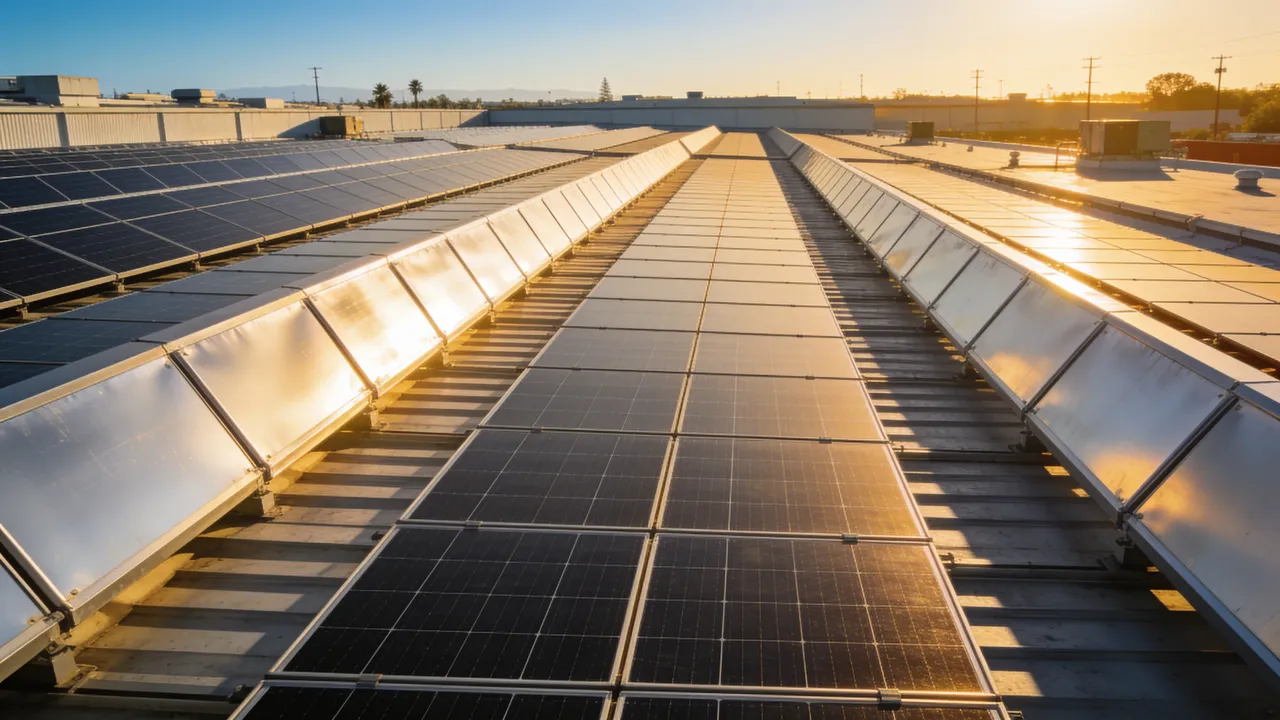
These two scenarios diverge most on price, and panel count is rarely the reason. Fremont's industrial parks host large flat-roof commercial arrays where ground-level access keeps per-panel costs lower than pitched-roof installations. A flat roof at grade level with an accessible panel field and a clear working perimeter is the most efficient commercial cleaning configuration. Panel count and soiling level are the primary quote variables.
A multi-story office building or elevated commercial facility adds crew time and, depending on edge configuration, OSHA-required safety equipment. The production gains from cleaning are the same regardless of access difficulty. What changes is what the job actually takes to complete safely, and Total Solar Cleaning prices that into the quote rather than using an average that doesn't apply.
Commercial cleaning method
The cleaning method matters for commercial arrays the same way it does for residential systems. Total Solar Cleaning uses deionized water and soft-bristle brushes on commercial jobs, the same method recommended in the maintenance guidance of major panel manufacturers. No chemicals, no pressure washing. For commercial arrays, the brushes are mounted on a robot with two soft-bristle brushes that moves three times faster than the brushes used on residential cleanings, which helps keep the cost down on larger installations. Commercial arrays that have been rinsed with tap water accumulate a mineral film layered over normal soiling. That film cuts light transmittance and comes off cleanly with deionized water.
Large commercial installations are also served by multiple technicians when the scope requires it, and Total Solar Cleaning offers weekend and early morning scheduling to minimize disruption during business hours.
Getting a commercial quote
All the variables above have concrete answers once Total Solar Cleaning reviews the installation. Panel count, roof configuration, last cleaning date if known, and whether a quarterly contract fits the property's schedule are the inputs that produce an accurate number.
The U.S. Department of Energy's guide to solar performance and efficiency explains how panel output is measured and what affects efficiency over time.
Call (833) 444-4173 for commercial inquiries, or request a quote online. Total Solar Cleaning is ISCA-certified, carries $2 million in general liability insurance, workers' compensation, and is bonded. Commercial quotes are based on the actual job, not national averages.