
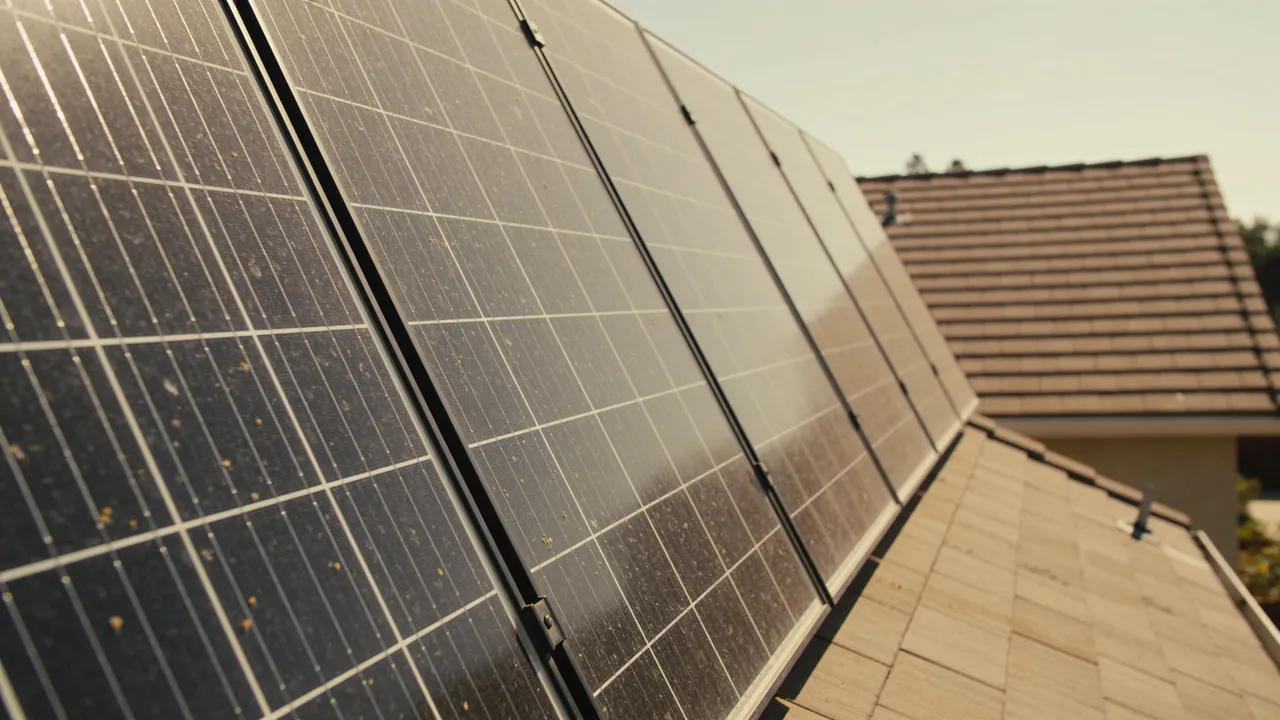
You've read that cleaning solar panels doesn't pay for itself. The study behind that is real, and for plain dust it's right. Here's where it stops applying.
What the UC San Diego study found
In a study released in 2013, engineers at UC San Diego analyzed output from 186 residential and commercial solar sites stretching from the San Francisco Bay Area to the Mexican border. Panels that went 145 days through a California summer drought without rain or cleaning lost only 7.4 percent of their efficiency. Washing a typical 5-kilowatt home system halfway through that summer would have gained about $20 of electricity.
Professor Jan Kleissl, the study's principal investigator, put it plainly: “Most homeowners won't get their money back for hiring someone to wash their rooftop panels.” The National Laboratory of the Rockies, known until recently as NREL, has a feature on solar soiling that puts the yearly energy lost to soiling at as much as 7% in parts of the United States, and describes cleaning as a trade between that lost energy and what the wash costs.
If your panels carry ordinary dust, sit at a decent tilt and get a wet winter, take the UC San Diego study at its word: an extra wash for the dust alone won't pay for itself.
When is solar panel cleaning worth it?
The same UC San Diego study names its own exception: panels heavily soiled with bird droppings should be cleaned, because droppings block sunlight and rain won't remove them. Bay Area roofs add a few more cases. Cleaning is worth the money when one of these is true:
- Bird droppings. They dry hard on the glass and stay through rain.
- Wildfire ash. Fire season drops ash on panels months before the first real rain, and a light shower tends to turn it into a muddy film instead of rinsing it off.
- Spring pollen the rain won't clear. Pollen is sticky, and in the Bay Area it peaks just as the rain stops for the year.
- Flat or nearly flat panels. The study found that panels tilted under five degrees lost more efficiency than steeper ones.
- A roof you shouldn't be on. Two stories up, a steep pitch or tile that cracks underfoot. Paying someone with the training and the insurance is cheaper than a fall or a broken roof.
Won't the rain clean them?
Bay Area rain cleans panels for part of the year. It falls mostly between November and April, and a winter storm rinses off loose dust for free. From May through October there's almost none, and those are the long sunny months when your panels produce the most. Rain was never going to lift droppings, and it does little for pollen that lands after the last storm of spring. Our post on whether rain cleans solar panels goes season by season.
When to skip an extra cleaning
Between the two scheduled visits, skip an extra cleaning if the glass shows only light, even dust and nothing you can point to. If the array is on the ground or a single-story roof you can reach from the ground with a soft brush on a pole, a gentle hose rinse on a cool morning handles that dust, and our guide to cleaning your own panels shows how. If you're not sure, call anyway and we'll tell you whether it can wait for the next scheduled visit.
What a cleaning costs, and what you're paying for
Residential cleaning runs $175 to $350 for 10 to 40 panels, and larger systems get a custom quote. That price won't come back to you in electricity. What you're paying for is droppings and ash off the glass before they bake on, a method that helps protect the solar equipment (deionized water, soft-bristle brushes, no pressure washer, no chemicals), and nobody in your house on a ladder.
For most Bay Area homes our standing advice is two cleanings a year: May or June, once the pollen has settled, and October or November, after fire season and the dry summer. Homes with heavy bird traffic, overhanging trees, nearby construction or low-tilt panels need more.
If rain won't fix what's on your panels, or you'd rather not climb that roof, call (833) 444-4173 or use the contact form for a quote.