
You just watched a driveway get pressure washed and you're wondering if the same machine works on solar panels. It doesn't. Panel glass, frames, and seals aren't built for that kind of force.
What pressure washing actually risks
Solar panels are built to a maintenance specification, and every major manufacturer's version of that spec calls for low-pressure cleaning, not driveway-grade equipment. Major panel manufacturers all set soft cleaning as the standard method. A pressure washer exceeds that range by a wide margin, and the risk isn't cosmetic. Enough force to strip grime off concrete can drive water past a panel's edge seals and into the laminate underneath, and the sudden pressure against tempered glass can crack a cell in a way that shows no damage from the outside.
None of that shows up the day of the wash. It shows up later, as a warranty claim the manufacturer traces back to the cleaning method and denies.
That doesn't mean every panel hit with a driveway pressure washer cracks on the spot. Most don't, at least not visibly. The risk is cumulative and often invisible until a manufacturer inspects a failed panel and traces the damage back to how it was cleaned, which is usually the same moment a homeowner learns the warranty doesn't cover it.
What soft washing actually means
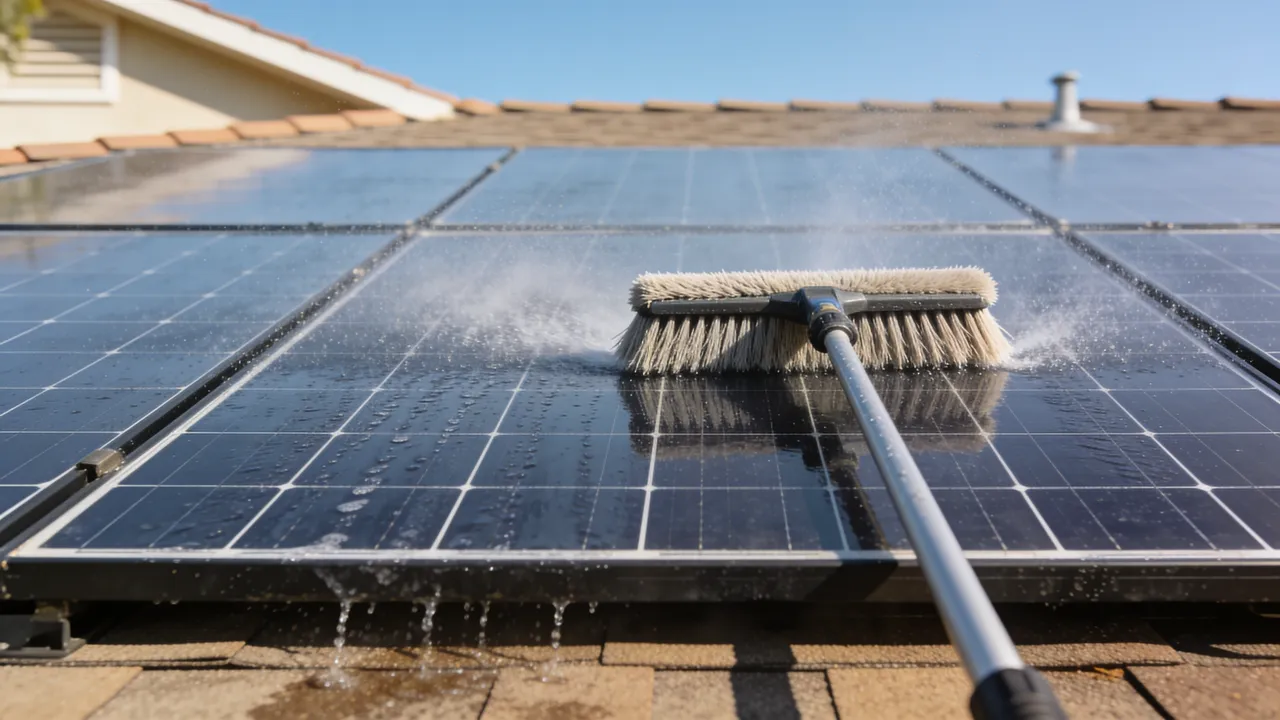
Soft washing keeps the pressure down and changes the tool. Total Solar Cleaning works from a water-fed pole with a soft-bristle brush, worked from the ground or the roof edge without walking across the array. That keeps weight off the panels and keeps the crew off exposed glass. The brush loosens what's bonded to the surface, and the water carries it away instead of forcing anything through a seal.
The water is half the method
Pressure isn't the only variable. What comes out of the pole matters just as much, which is why Total Solar Cleaning uses deionized water held under 10 parts per million of dissolved minerals, the same standard we cover in our post on why deionized water beats tap water for solar cleaning. Tap water evaporates and leaves its minerals behind as a film. Deionized water evaporates clean. Combine that with a soft brush at low pressure and the panel comes back clear without anything added to the glass, and without anything forced past it.
Why the warranty question comes up here first
Manufacturer guidance treats routine cleaning as expected, not risky, a distinction we cover in full in our post on whether cleaning voids a solar panel warranty. The risk is specific to the method. Pressure washing and abrasive tools are the two things that actually void coverage, and soft washing with deionized water meets the manufacturer standard by definition. It's also exactly what International Solar Cleaning Academy certification trains a technician to do. Total Solar Cleaning is ISCA certified and uses this method on every job.
DIY pressure washing is free until it isn't
The pressure washer already sitting in your garage costs nothing to point at a solar panel. That's exactly the problem. There's no cost the day you do it. The cost shows up if a cell cracks or a warranty claim gets denied, and by then the math has already flipped against you. We cover the cases where DIY solar cleaning genuinely is safe in our guide to what's safe to clean yourself and when to call a pro - ground-mounted and single-story systems with a soft brush and the right water are fine to handle yourself. A pressure washer isn't one of the safe options, on any roof.
What this looks like in Concord, Pleasant Hill, and Brentwood
Concord's dry-season dust film comes off with low pressure and deionized water, no pressure washer required. Pleasant Hill's mature-tree neighborhoods add pollen and organic debris that a soft wash lifts without stressing the glass, and Brentwood's east-county dust and hard water make the deionized rinse the difference between clean glass and a mineral film.
Call (833) 444-4173 to schedule a soft wash with deionized water, or request a quote online. Your panels get clean without anything getting forced through a seal.