
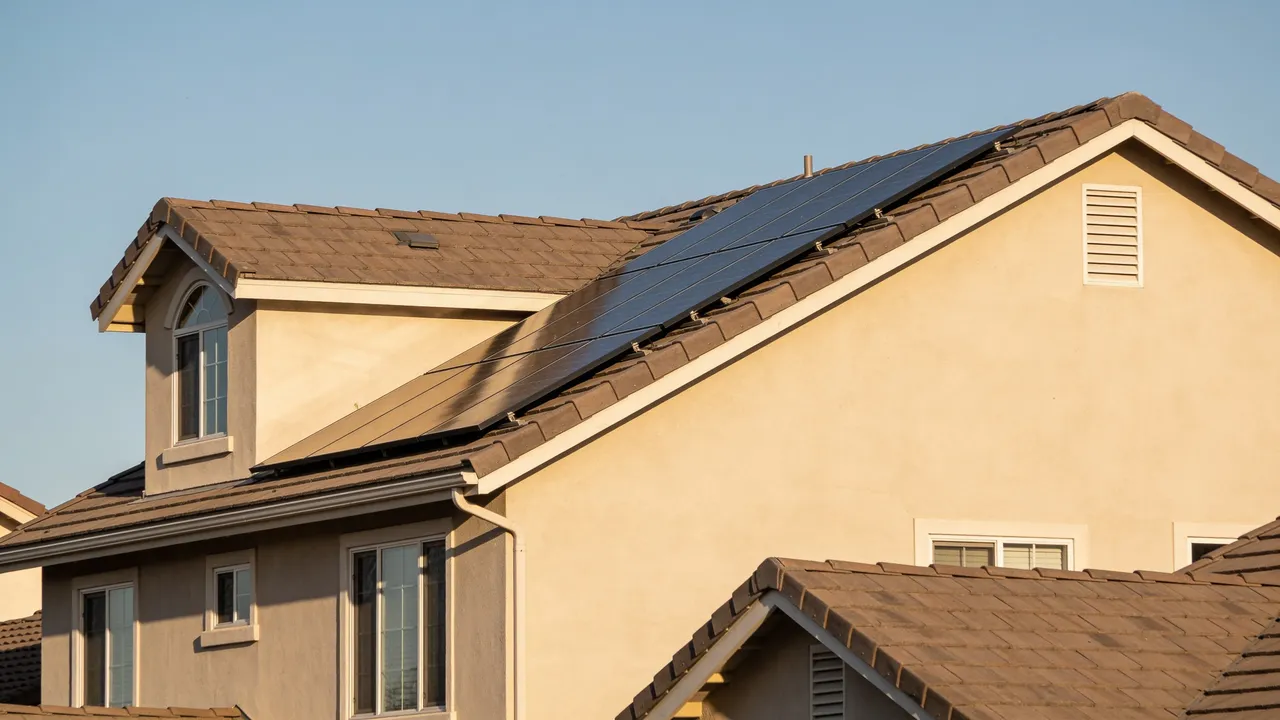
You can clean your own solar panels. Whether you should depends on three things: how high the roof is, what is on the glass, and what water you have access to.
When DIY makes sense
Ground-mounted arrays and single-story roofs with safe, stable ladder access are the best candidates for DIY solar cleaning. The conditions where it works cleanly:
- Ground mount, or single-story roof with a gentle pitch and a stable ladder position
- No bird droppings visible from the ground (see below for why droppings change the calculation)
- Soiling is light dust or pollen only
Equipment: a soft-bristle brush on an extendable pole, and deionized, reverse-osmosis filtered, or distilled water. Not tap water. East Bay tap water averages around 150 ppm total dissolved solids. Cleaned with tap water and dried in the sun, the mineral residue left behind reduces light transmittance the same way the original dust did.
The two-story calculation
Solar panel arrays are installed in grouped rows. Cleaning a full array means moving across the roof, not standing in one spot. On a two-story roof, that motion adds real fall exposure.
Total Solar Cleaning's crews use roof brackets, harnesses, and fall protection equipment as standard practice. You are comparing that setup to a home ladder on a Saturday morning. A fall from two stories does not need to hit ground level to be catastrophic.
In Orinda, where hillside homes often have solar installed at angles that make roof access genuinely dangerous without proper gear, the question usually answers itself.
Why bird droppings change the calculation
Hosing bird droppings off panels does not work, and trying it creates a new problem. Uric acid in droppings does not dissolve cleanly in water without mechanical action. A garden hose spreads a diluted uric acid solution across the panel surface. When that dries, it leaves a fine haze across the glass rather than a concentrated spot, and that haze cuts light transmittance across the full panel.
Droppings also cause hot spots. The shaded cell absorbs current from the rest of the panel string and converts it to heat. That thermal stress is cumulative. Getting a dropping off cleanly requires a wet microfiber and mechanical action, not a hose.
If droppings are visible from ground level on a two-story roof, call a professional. DIY at that height with a method that doesn't fully work is the worst combination. The bird droppings post has the full breakdown on why rain and garden hoses can't clear them.
The right method when you do DIY
If your setup meets the safe-access criteria above, here is what works:
Water first, then wipe. Soak the panel surface and let it soften for a minute before wiping. Dry-wiping grinds dust across the anti-reflective coating and scratches it.
Soft brush or damp microfiber only. A soft-bristle brush on an extendable pole handles most accessible panels without getting on the roof at all. Nothing abrasive.
No pressure washer. High pressure forces water past panel seals, can crack cells, and voids most manufacturer warranties. The approved method is deionized water and a soft brush, not a power washer.
Clean in the morning or late afternoon. Panels heat up in direct sun. Cold water on a hot panel can thermal-shock the cells. Early morning or late afternoon avoids this.
Distilled water from a grocery store works. If you don't have a DI or RO system, store-bought distilled water is an acceptable substitute. Around $1 per gallon and it leaves no mineral residue.
The honest bottom line
Total Solar Cleaning will tell you when you probably don't need us. Ground-mounted or single-story, no bird activity, light dust or pollen: DIY with the right method and water is fine.
Two-story or steep-pitch roof, visible bird droppings, or a production drop you can't explain from the ground: the professional cleaning protects the panels and warranty and removes the fall risk from your weekend. Lafayette homeowners with ground-mounted systems on sloped backyards sometimes handle their own cleaning. We'll tell you when that's fine and when it isn't.
Residential cleaning runs $175 to $350. For most East Bay systems, a clean removes the bonded soiling rain can't and protects the panels and warranty. Call (833) 444-4173 for a straight answer on your setup, or request a quote online. You don't need to be home. Leave the gate unlocked and Total Solar Cleaning handles the rest.