
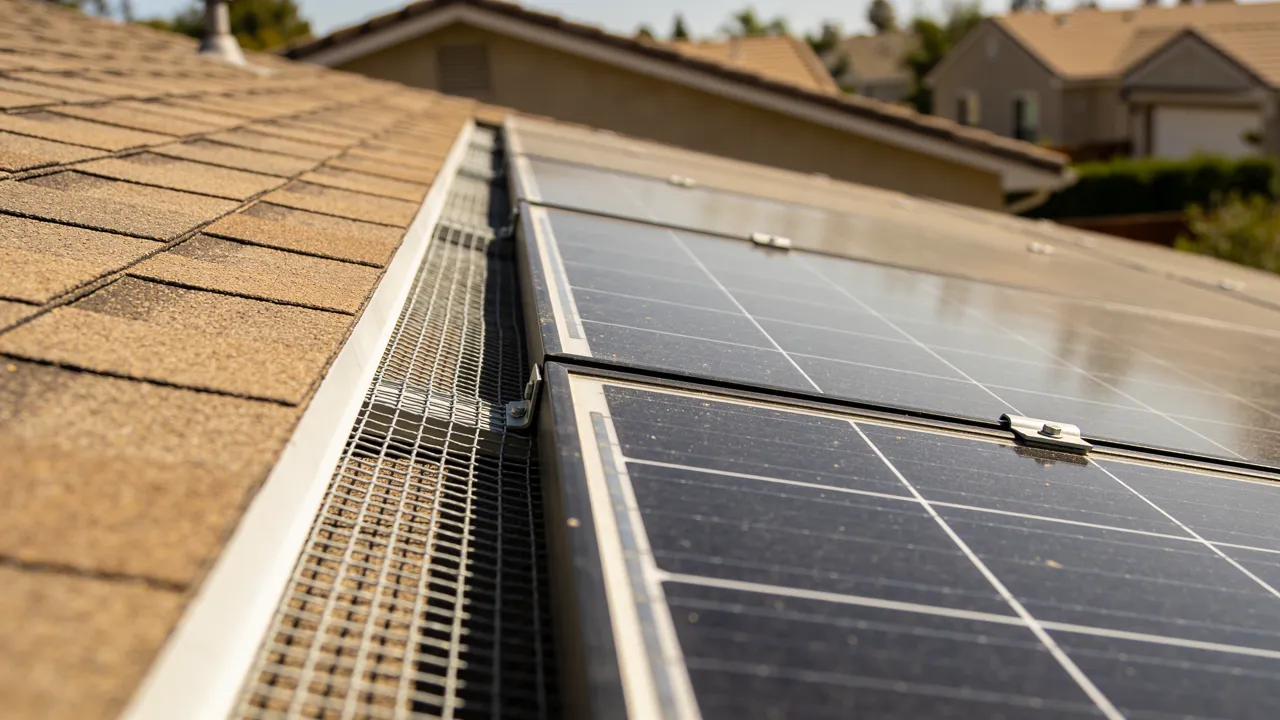
A squirrel ran off your roof, and a few days later the solar app is showing an error. Take the pair seriously. The wiring under the panels is exactly where squirrels like to chew.
Why squirrels chew solar panel wires
Rodents gnaw constantly. A squirrel's front teeth keep growing for its whole life, so it chews to keep them filed down. Under a solar array, the wiring and connectors run along the gap between the panel frame and the roof. That gap is sheltered and warm, the same spot pigeons pick for nesting, and the cable inside it is the nearest thing to chew.
Rats and mice gnaw the same way. Tree squirrels get most of the blame because they're the ones you see on the roofline. The University of California's Pest Notes on tree squirrels names the eastern fox squirrel, an import from the eastern U.S., as the most serious pest around California homes and gardens, and notes that squirrels sometimes gnaw on telephone cables. Solar cable sits a lot closer to where they spend the afternoon.
How to tell if rodents are chewing your wiring
Chewed wiring sits out of sight under the panels, so the signs reach you sideways. Watch for these:
- An arc-fault alert or inverter error code with no other explanation.
- The system, or one section of it, dropping to zero on a sunny day.
- Leaves, sticks or nest material poking out from under the panel edges.
- Droppings on the roof or squirrels running the roofline above the array.
If an arc-fault alert comes back after one restart, stop resetting it and call your installer with the error code and a screenshot of the monitoring app. Confirming chewed wiring takes someone on the roof looking under the panels.
Is chewed solar wiring dangerous?
Yes, chewed solar wiring is dangerous. Solar panels produce voltage whenever light hits them, so the wiring on the roof stays live even with the inverter switched off. Chewed insulation exposes the conductor, and a damaged conductor can arc. A spark next to dry leaves and nest material is a fire risk.
Fire risk is the reason the National Electrical Code, since its 2011 edition, has required DC arc-fault protection on rooftop solar circuits of 80 volts or more (section 690.11). When that protection detects an arc, it shuts the system down, and many inverters stay off until someone restarts them. The shutdown is the protection doing its job. The wiring still needs repair, and until it's fixed, the system stays down. Keep hands, poles and hoses out from under the array in the meantime.
How to stop squirrels getting under solar panels
To stop squirrels getting under solar panels, seal the gap between the panels and the roof. Critter guard mesh runs around the edge of the array and closes that space, so the animal never reaches the wiring. The mesh clips to the panel frame, with nothing drilled into the panels or the roof, and air still moves under the array to keep the panels cool. It's the same guard used against nesting pigeons, so one installation handles both. Our post on pigeons nesting under solar panels covers that side. The price depends on the length of array edge and the roof access (see solar panel bird proofing cost).
Cut back branches that touch the roof, too. Oak and pine limbs over the house give squirrels a bridge straight onto the array, which is a common setup on hillside lots in Lafayette and Orinda and under the mature canopy in Walnut Creek. Skip the poison: the same UC Pest Notes say poison bait is illegal for every tree squirrel species in California, and tree squirrels are game mammals under state law, so trapping is regulated too.
Will a cleaning fix chewed wiring?
No. A cleaning washes the glass, and that's all it does. It won't repair a chewed conductor or clear an arc-fault shutdown. Wiring repair is a job for your solar installer or a licensed electrician, and it comes first. The guard goes on after the repair, so the damage is fixed before the gap is closed.
Total Solar Cleaning installs critter guard and cleans panels. We don't do electrical repair, and if we see chewed wiring we'll tell you it needs an electrician before any guard goes on.
Once the wiring is sorted, call (833) 444-4173 or use the contact form for a critter guard quote. We serve Contra Costa and Alameda counties from Concord.