
A solar panel maintenance plan is a cleaning schedule, not a product upgrade. What you are buying is a lower price per visit plus dates the crew already holds, and the discount is smaller than most homeowners expect.
What a maintenance plan covers
A plan sets cleanings on a fixed rhythm at a rate below the one-off price, and it holds the next date so you never have to remember it. Total Solar Cleaning's residential plans come in two versions. The annual plan covers one cleaning a year at 10 percent off standard pricing. The semi-annual plan covers two cleanings a year at 15 percent off.
The twice-a-year schedule lands on the two windows that carry the most weight in the East Bay: late spring, once the pollen finishes, and late fall, after fire season eases and before the winter rains arrive. An array that enters the rainless stretch already clean never gives bonded soiling a full summer to set, and the second visit is what buys that.
A plan covers cleaning and a visual inspection of the array. Electrical repair, a replacement inverter, and roof work sit outside it. A cracked tile or an offline microinverter gets documented and reported on the visit, and the repair goes to an electrician or your installer.
What the discount is worth on a real invoice
Published residential pricing in the SF Bay Area runs $175 to $350, quoted by panel count. Systems of 10 to 20 panels land at $175 to $225, 21 to 30 panels at $225 to $295, and 31 to 40 panels at $295 to $350, with anything larger quoted custom. A 25-panel system in the middle of its bracket, call it $260, pays about $26 less on the annual plan, or about $39 less on each of two visits under the semi-annual plan. A ground-mounted array quotes lower for the same panel count, so the dollar figures move with the mount as well as the count.
The price list carries larger discounts than the plan rate. Bundling a cleaning with gutter cleaning saves 15 to 20 percent on that combined visit, and adding bird proofing to a cleaning saves 10 percent. Both apply once, to a visit you were booking anyway. The plan rate applies every time the crew comes back, so the comparison worth making spans two or three years.
The commercial version of the same idea is a quarterly contract at about 20 percent off, with priority scheduling and a written report after each visit. Different buyer, different product, and outside what this post covers.
Where the bigger discount on twice-a-year cleanings comes from
The 15 percent tracks the labor a visit costs, and a system cleaned twice a year costs less labor than one that has waited a year. It arrives at each visit in better shape than an array that sat through a full dry season, and better shape means less time on the roof. The first cleaning on a neglected array costs more than the visits that follow it, because bonded soiling takes extra passes to lift safely. A semi-annual plan steps off that first-clean premium after year one, so the percentage follows the work the crew does.
Annual or semi-annual: which fits your roof
Choose semi-annual when two or more of these conditions hold on your property:
- Birds land, roost, or nest on the array. Droppings arrive in concentrated spots and rain does not lift them.
- Trees stand close enough to drop pollen and leaf debris onto the roof.
- The house sits where dry-season dust moves, in the eastern county corridor or anywhere the Diablo winds carry hillside dust across rooftops.
- The roof sees ash from fire season, which bonds to warm glass.
- The array sits in shade long enough to stay damp, which is where growth starts at the frame line.
An annual plan covers a system with none of those: an open roof, no bird activity, light dust and nothing more. Semi-annual is the published recommendation for most Bay Area homes, and the conditions above are what drive it. The cadence itself is walked through in our guide to how often to clean solar panels in the Bay Area.
What happens on a scheduled visit
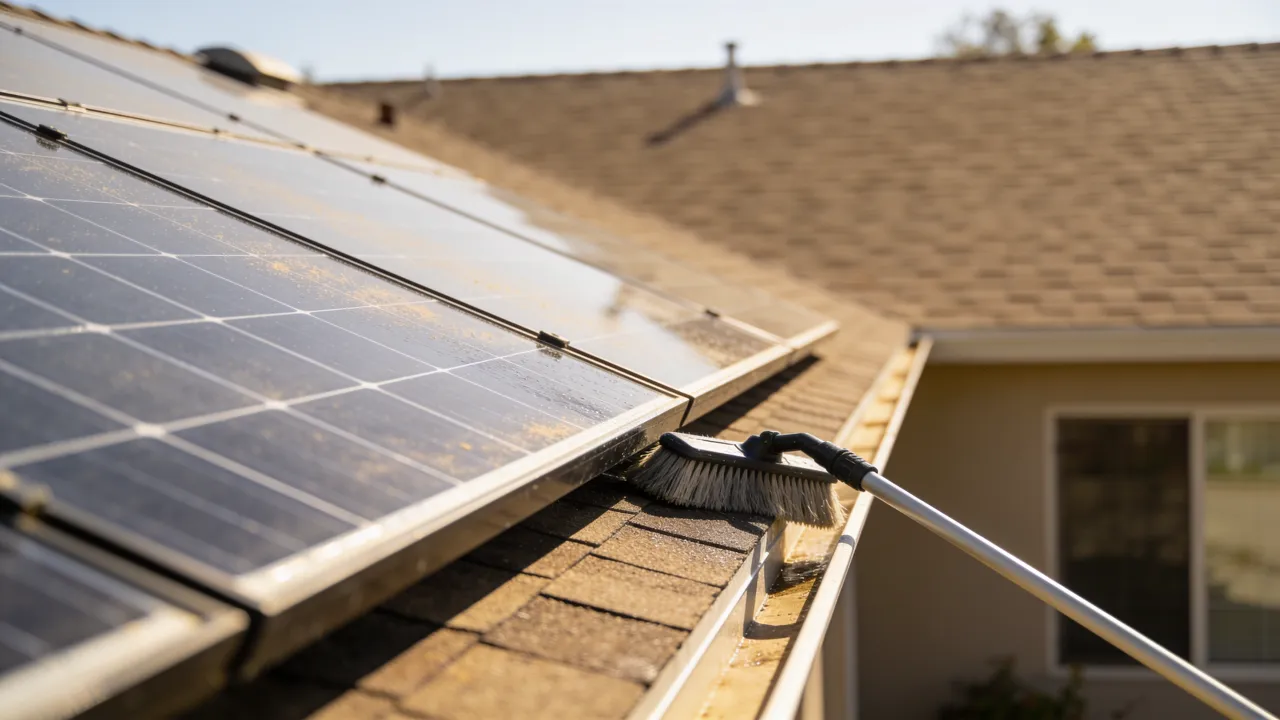
Every visit uses the same method. Deionized water held under 10 parts per million of dissolved minerals, applied with soft-bristle brushes, no chemicals and no pressure washing. East Bay municipal water averages around 150 parts per million, so a plan that rinsed with a garden hose would build the mineral haze it was hired to remove. The method follows the cleaning guidance published by SunPower, LG, Panasonic, and Enphase, and repeating it on a schedule is the whole point of a plan.
A visit ends with a visual inspection of the array, and before-and-after documentation is available on request. The series of dated visits becomes the maintenance record a manufacturer warranty assumes when it lists periodic cleaning as the owner's responsibility. Scheduling typically runs 3 to 7 business days out, and nobody needs to be home.
When a plan is the wrong buy
The first case is a single event with nothing recurring behind it. Ash after a smoke week, or one round of droppings from a bird passing through, comes off in one visit. If no colony has moved in under the panels, no tree line overhangs the array, and no dust source sits upwind, there is nothing for a schedule to protect.
The second case is a house about to be sold. A plan's value accumulates across visits, so a homeowner listing in a few months gets more from a single clean before the listing photos than from a schedule that follows them to a new address.
The third case is a problem that is not soiling. Shade from a tree that grew, a microinverter that dropped offline, or a hot spot under a damaged cell will not improve with more cleanings. A plan would keep the glass clean and leave the production figure where it already sits.
Where the semi-annual rhythm fits hardest: Walnut Creek, Brentwood, and Danville
Walnut Creek's tree pollen and fog deposits put most homes on a twice-a-year rhythm, the cadence where the semi-annual plan discount applies. Brentwood's agricultural dust pushes many systems to a third clean a year, where a plan spreads the cost across more visits. Danville's larger two-story arrays carry more glass to protect, so the dated cleaning record a plan produces matters for the warranty.
Total Solar Cleaning is ISCA certified, carries $2 million in general liability coverage, and cleans with deionized water and soft-bristle brushes on every visit. Call (833) 444-4173 to set up an annual or semi-annual plan, or ask for a single-visit quote if your roof does not need a schedule.