
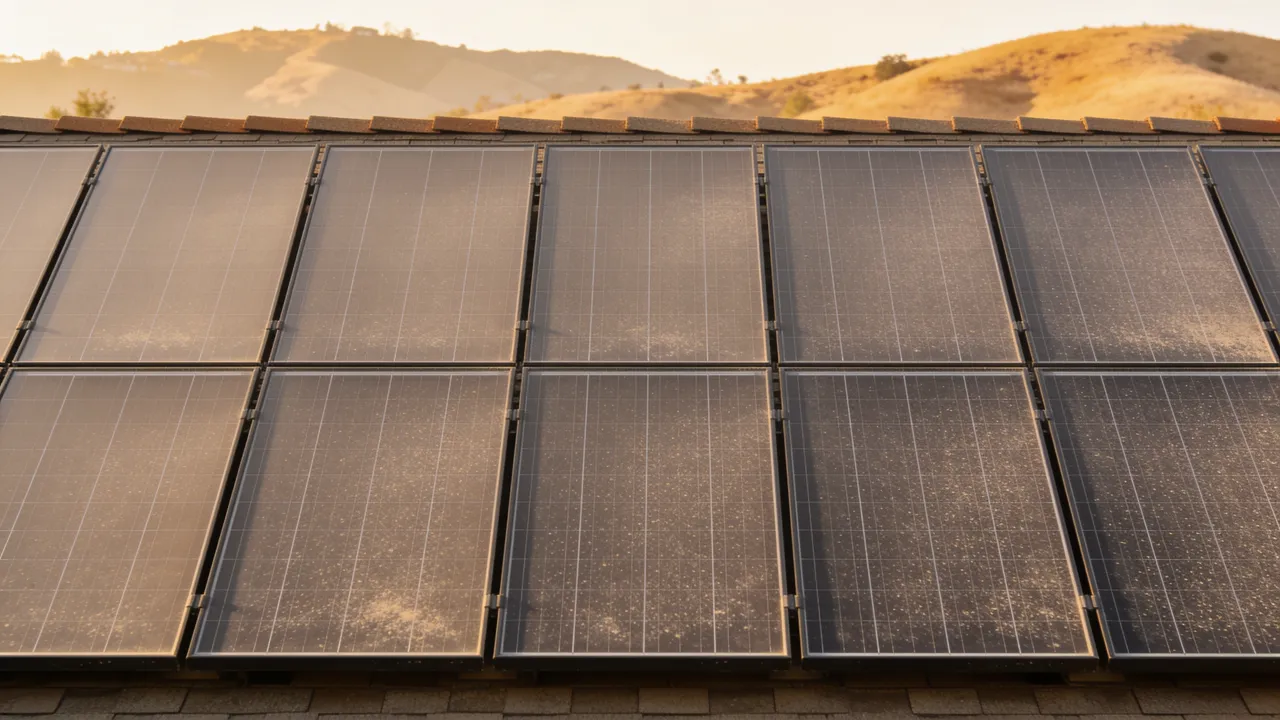
The dust film on your panels builds fastest in late summer, and most homeowners never connect it to the wind. The Diablo winds are the mechanism behind it.
What the Diablo winds actually do
A Diablo wind is a hot, dry offshore wind that blows out of the northeast, off the interior of California and over the coastal ranges toward the Bay. The driving force is high pressure building over the Great Basin, which pushes air down the western slopes of the mountains. As that air descends it compresses, warms, and dries out. By the time it reaches Contra Costa and Alameda counties it can be hot, fast, and almost desert-dry, with humidity sometimes dropping below 10 percent. The National Weather Service Bay Area office tracks these as Red Flag wind episodes because of how easily they spread fire.
What that wind does to a rooftop is simple. It picks up fine dust from dry hillsides, agricultural ground, and construction sites, and carries it across the valley. The dust lands on warm panel glass and sits there, because nothing is washing it off.
Why nothing rinses it through the dry months
The Bay Area gets almost no measurable rain from May through October. That is exactly the window when the Diablo winds blow hardest, and exactly the window when the sun is highest and your panels produce the most. So dust lands on the glass every few weeks and accumulates, with no rain to interrupt it. The soiling calendar we walk through in our guide to the best time of year to clean Bay Area panels treats late summer as the peak of that buildup, for this exact reason.
Dust is loose on its own. The problem is what it sticks to.
Fine dust on clean glass is the easy version of the problem. It sits on the surface and would rinse off in a real rain. The complication is that by late summer your panels are not starting from clean glass. They have been carrying a pollen film since spring, and that film is tacky. When a layer of Diablo-wind dust settles on top of it, the dust sticks to the tacky surface instead of blowing back off.
That is when a loose dust problem turns into a bonded film. Now the panels carry pollen and dust together, in a layer that rain will not fully lift. We cover the mechanics of that in why rain does not actually clean Bay Area solar panels: wet pollen dries into a tighter coating than dry pollen, and once dust binds into it the film only thickens with every dry week.
Where wildfire ash fits in
The same Diablo wind pattern that carries dust also drives smoke and ash from fires burning in the Diablo Range and further north straight into the East Bay. Ash behaves differently from loose dust. It bonds chemically to warm glass and can etch the surface if it sits through repeated fog cycles. A rooftop that already carries a summer dust and pollen film gives ash something to bind into, which is why a late-summer clean matters more once fire season arrives. The full breakdown is in our post on wildfire ash on Bay Area solar panels.
What a late-summer film looks like from the ground
You can usually spot it from the driveway. A dust-coated array reads as a uniform grayish haze rather than the dark reflective blue of clean glass. The film tends to sit evenly across the array, unlike bird droppings which show up as concentrated spots. If your monitoring app shows a slow, steady production decline over the dry weeks while the weather stays clear and sunny, that is the signature of soiling, and the wind pattern tells you why.
When to book the clean
The highest-value slot on the East Bay cleaning calendar is early fall, after fire season eases but before the first steady rain. That clean pulls a full dry season of dust, pollen residue, and any ash off the glass before rain gets a chance to bond it into something harder to remove. Book too early and you are still inside fire season. Book too late and the first storm has already turned dry soiling into a film. Total Solar Cleaning books that window every year rather than pinning it to a fixed date, because the wind and rain do not check a calendar.
What this looks like in Concord, Antioch, and Walnut Creek
Concord sits in the Diablo wind corridor, where the late-summer dust load builds fastest, so a late-summer clean carries more weight here than closer to the coast. Antioch's east-county location gets the hottest, dustiest end of the Diablo wind pattern, and the film there often shows up earlier and thicker than in the valleys closer to the Bay. Walnut Creek's tree cover adds organic debris to the dust film the dry months leave behind, so panels there carry a mix of wind-blown dust and tree debris by August.
Total Solar Cleaning pulls that late-summer film off with deionized water and soft-bristle brushes, the warranty-safe method that leaves no mineral haze behind. Call (833) 444-4173 to book a clean timed to the wind season, or request a quote online. You do not need to be home for the work itself.