
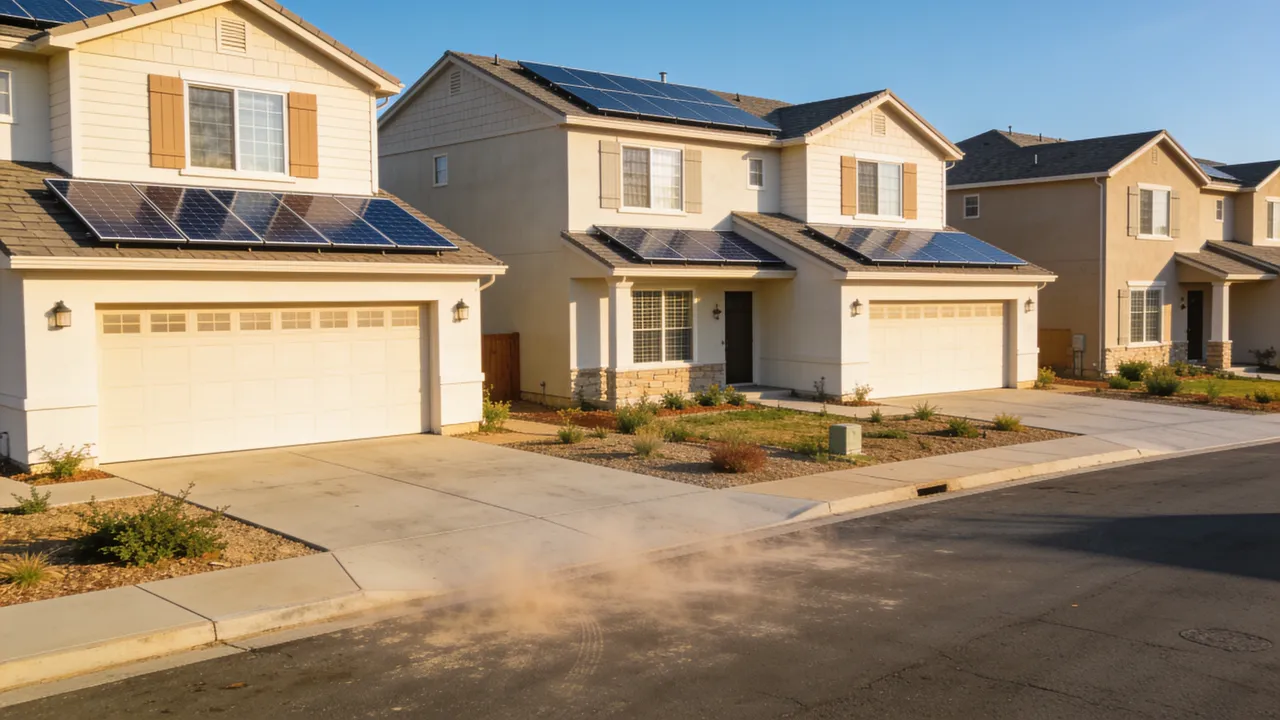
An HOA board member owns a different problem than a single homeowner. Many similar roofs, one budget line, liability exposure, and residents who each expect their array treated the same way. Here is what it takes to get right.
What makes HOA solar cleaning a different job
A single-home clean is one roof, one ladder setup, one set of access decisions. A community property runs the same job across dozens of roofs at once, and the complexity is in coordination, not in the cleaning itself. Every array in the community was likely installed around the same time by the same contractor, which means the panels, the mounting, and the access conditions are similar from home to home. That consistency is the efficiency advantage, but it only pays off if the vendor can actually manage a multi-home schedule.
The board also owns a liability question that a single homeowner does not. Putting a vendor on multiple roofs in the community puts a crew on a live electrical system at height, repeatedly, across properties where residents, insurers, and the HOA itself all have a stake in the outcome. That is why the verify-first questions matter more here, not less.
How multi-home scheduling actually works
The same logic that makes a commercial maintenance contract efficient at a single large site applies here, just spread across individual homes. One mobilization brings the crew, the deionized water system, and the equipment to the community for a block of consecutive days rather than sending a truck to the same neighborhood a dozen separate times. We walk through the multi-site efficiency model in detail in our guide to commercial solar panel cleaning across the SF Bay Area, and the scheduling math is the same. The fewer times a crew has to pack up, drive, and set up, the lower the per-home cost.
In practice, a community clean runs home by home down a street or cluster. The crew finishes one array, moves the equipment to the next roof, and repeats. A townhome community with 30 arrays on similar single-story roofs clears faster than the same panel count spread across detached two-story homes, because the setup time between jobs is shorter.
What the board must verify before any crew gets on a roof
Three credentials separate a vendor the board can sign a contract with from one that creates exposure. The same verify-first list a homeowner uses to choose a cleaner applies here, but the stakes are higher because the board is responsible for every roof in the community.
ISCA certification means the crew trained on electrical safety around live PV systems and cleaning methods that follow manufacturer guidelines, the standard published by the International Solar Cleaning Academy. General liability insurance of at least $2 million protects the community if something goes wrong on any of those roofs, not a verbal assurance from a sales call. And Cal/OSHA fall-protection compliance is not optional on a rooftop job, and on a two-story community roof it is the line between a professional mobilization and an uninsured risk.
Total Solar Cleaning is ISCA certified, carries $2 million in general liability insurance, and follows fall-protection safety practices on every job. A board should ask for the certificate of insurance and the ISCA credential before signing anything, and a legitimate vendor sends both without hesitation.
How pricing scales across a community
Pricing for a community clean is quoted per home, not as a single flat number for the whole property. Each home is assessed by panel count, roof access, and soiling level, the same three variables that drive a single-home quote. The difference is volume: a community that books a full mobilization gets the efficiency of shared setup, shared travel, and a single coordinated schedule, which lowers the per-home cost compared to booking each home separately.
A vendor who quotes a flat per-panel rate across an entire community without looking at the roofs has not done the work. Two-story homes with steep pitches cost more to service than single-story townhomes, even with identical panel counts, because the access setup is different. An honest quote reflects that, home by home, and a flat per-panel gimmick papers over it.
What the board should require in writing
A community cleaning agreement should spell out four things before the crew arrives. The scope: which homes are included, the panel count per home, and what the cleaning covers. The method: deionized water and soft-bristle brushes, no pressure washing, so no array in the community ends up with a warranty problem. The schedule: which days the crew mobilizes and how residents are notified. And the documentation: a per-home cleaning record the board can keep on file for warranty, insurance, and maintenance-history purposes.
That last item matters more for an HOA than for a single homeowner. Manufacturer warranties often require periodic cleaning as part of the maintenance the owner is responsible for, and a dated record of professional cleanings across every home in the community is exactly the documentation a warranty claim needs. A vendor who cannot or will not provide per-home records is the wrong vendor for a community property.
The cleaning method stays the same on every array
The method does not change from home to home within a community. Total Solar Cleaning uses deionized water held under 10 parts per million of dissolved minerals, applied with soft-bristle brushes and no pressure washing, on every array. That method follows the published cleaning guidelines of the major panel manufacturers whose panels sit on community roofs. Every resident gets the same standard, regardless of where their home falls in the mobilization order.
When a cleaning will not fix it
An honest vendor tells the board when a cleaning is not the right call for a given home. If a resident's panels are shaded by tree growth, a cleaning will not restore that output. If an inverter is offline or a breaker has tripped, a cleaning will not touch it. If the gutters on a community building are overflowing and sending debris up the roofline, that is a gutter-line service, not a panel-cleaning problem. A vendor who books every home in the community for a cleaning without flagging the ones with a different problem is billing for work that will not help.
Total Solar Cleaning will flag those homes in the mobilization report rather than quietly cleaning around an issue the board should know about.
What this looks like in Walnut Creek, Pleasant Hill, and Danville
Walnut Creek's townhome and condo communities often have dozens of similar arrays that clean efficiently in one mobilization, which is the setup where shared scheduling lowers the per-home cost the most. Pleasant Hill's planned communities pair mature trees with rooftop solar, a combination that soils panels faster than open lots, so those communities tend to need cleaning on a more regular cadence. Danville's larger HOA communities carry two-story roofs where verified fall protection is non-negotiable, and the credential check matters most on those properties.
Total Solar Cleaning is based in Concord and services HOA and community properties across Contra Costa and Alameda counties. For a community cleaning quote or a walkthrough of the property, call (833) 444-4173, or request a quote online. Residential homeowners can reach the residential line at (833) 444-4173.